
100 interviews.
One AI.
A single day.
Your people take a half-hour call with an AI agent, as many at once as you need. What comes back is how your company really runs: the processes, the detours, the know-how that never left anyone's head. Once a consulting project, now a single day.
An AI agent that listens to your whole company.
The important stuff happens between the processes: friction, delays, the cases nobody planned for. Everyone involved knows exactly what works and what doesn't, each within their own line of sight. Little of it travels upwards, and nobody sees the whole picture. DeepListen listens to every one of them and puts it together.
- 01
Set the questions
You say what you need to know. A process, a department, a problem that keeps coming back. DeepListen turns that into the interview guide.
- 02
Book a time
Your people get an invite and pick the time themselves. Whenever it fits their day. The AI always has time.
- 03
Talk to the AI
One call, half an hour. The agent listens, follows up, stays with it. A hundred conversations run at once.
- 04
Get the findings
What comes back is what used to sit scattered in people's heads. Detailed and pulled together, as a report and a process map.


Conversations become a clear picture.
Not an archive of transcripts, but findings you can act on. Every one of them traces back to the conversations it came from.
Many conversations. One document.
DeepListen works through every conversation one by one and brings it all together in a single document. At the top, what the leadership needs to know. Below it, the detail down to the individual step. You see the status quo at a glance and hold the groundwork that optimisation, digitalisation and AI projects build on.
The external Mercura API in daily use
Touchpoints, friction, workarounds
Client: Weber Fulfillment GmbH · Process capture: Mercura backend · 14 voice interviews, 11 August 2026
- 1Summary1
- 2Campaign and method3
- 3Touchpoints5
- 3.1Setup and onboarding5
- 3.2Day-to-day operation7
- 4Intended versus actual9
- 5Friction points11
- 5.1Missing features11
- 5.2Errors13
- 5.3Configurability14
- 5.4Documentation15
- 5.5Support and response times16
- 6Workarounds17
- 6.1Order numbers, backend to ERP17
- 6.2Points expiry via export18
- 6.3Prices and shipping costs in Excel19
- 6.4Extra features built from exports20
- 6.5Actions straight through the API21
- 6.6Account deletion in the database22
- 6.7Shipping status by group email23
- 7Friction in numbers24
- 8Declined programme requests26
- 9Requests and areas to act on27
- ARequired questions and coverage29
- BQuotes by theme30
- CInterview transcripts (separate)
Fourteen people from key account management and support, purchasing and planning, IT and product, sales and the executive team spoke with the DeepListen agent on 11 August 2026, half an hour on average. Every conversation fed into this report.
In standard operation Mercura is considered stable. Friction appears wherever a programme goes beyond the standard, and that is the case with almost every customer. Four findings run through every area.
Expected features are missing. The gaps get closed with workarounds, the data maintained in two systems side by side. The inconsistencies only surface at the customer.
The API is poorly documented. What a function does is worked out by trial or asked of the vendor, with waits of several working days.
The interface is not enough to run on. Recurring actions are done by hand through the API. Few people can, it takes time, and it produces errors.
Customers get turned away. At least three programme requests with attractive volume had to be declined for want of features. Until now that appeared in no report.
The extra effort appears in no ticket and no cost account. It lives in the heads of the people doing it. Cases, times and quotes in chapters 6 and 7.
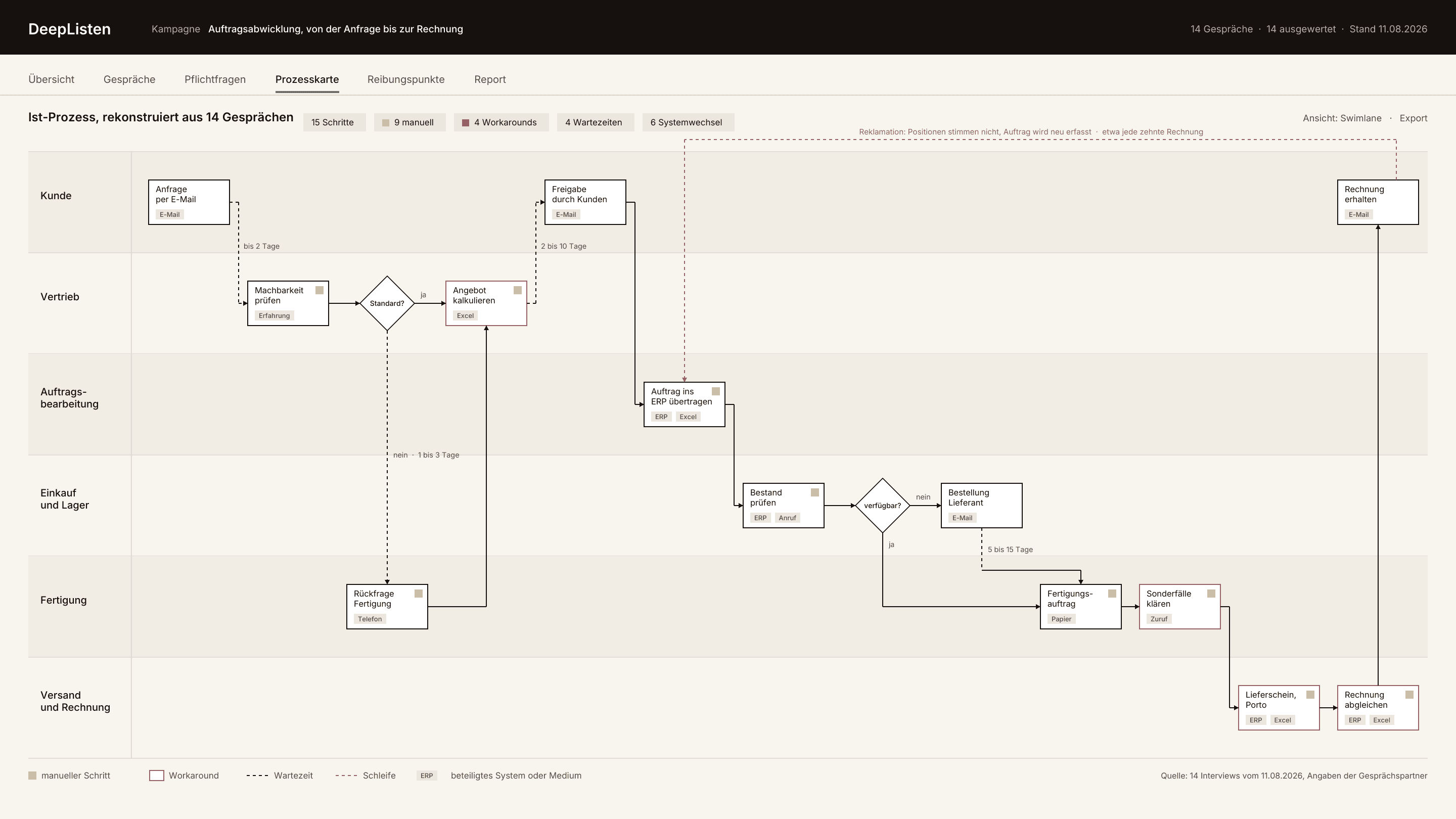
The process as it actually runs
Rebuilt from every conversation: each step, each system switch, each wait, each workaround. Not the flow in the handbook, but the one people work around every day.
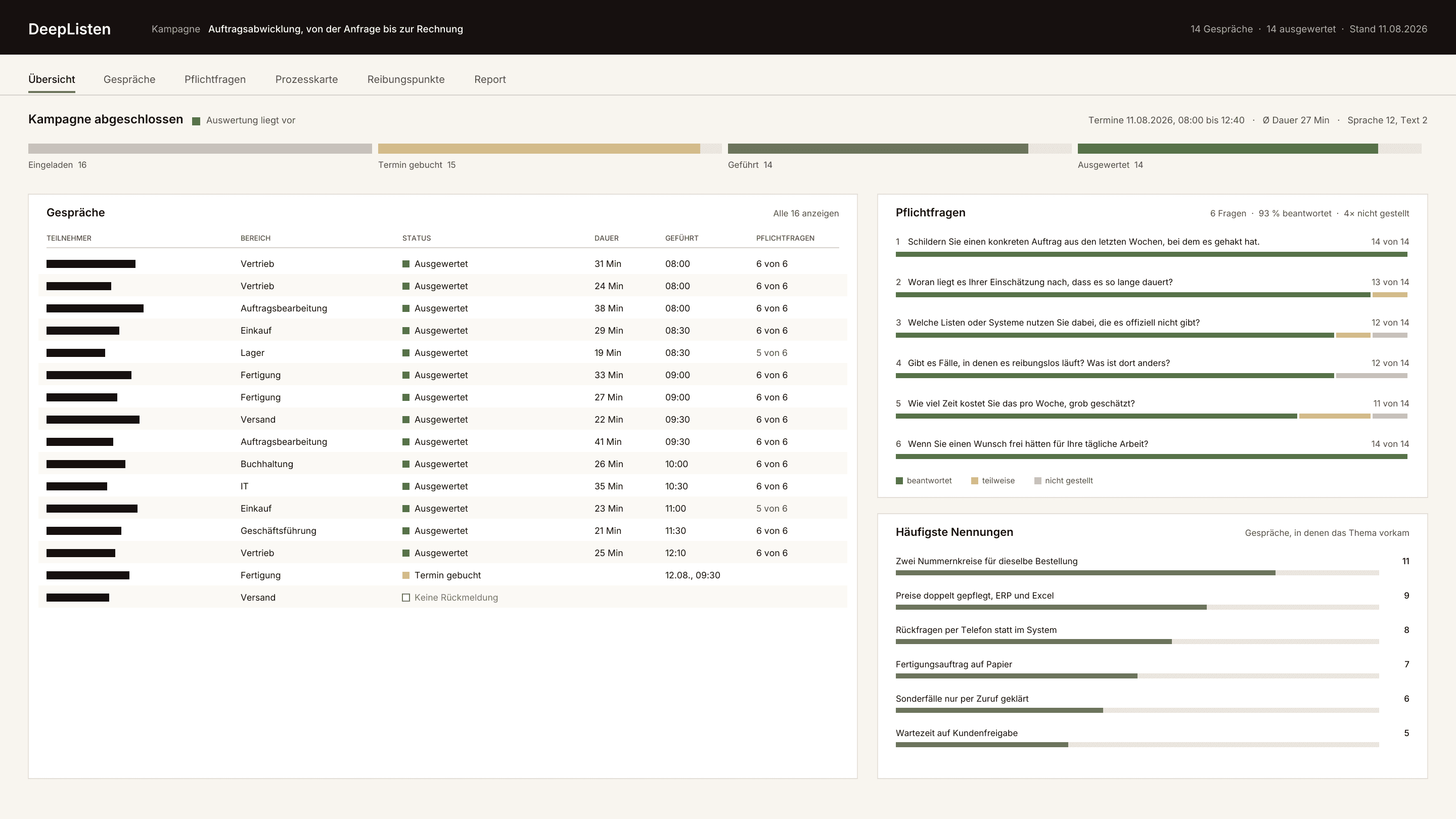
Every conversation at a glance
Who spoke, for how long, which questions got answered, which themes came up most. Any line in the report leads straight back to the conversation behind it.
The AI pressure is here, the AI effect isn't.
The licences are paid for, the copilots are live. A few people search and write a little faster. But the way you work hasn't changed. What was inefficient still is. The friction lives in your processes, and what people know about them stays in their heads.
- The problem
There's no quick AI fix for everything
AI works on top of clean processes, not in place of them. Roll it out and it exposes whatever digitalisation left behind. Without that groundwork, AI stays a glorified writing assistant.
- The answer
Your best consultants are already on payroll
Nobody knows how the work really flows better than the people doing it every day. They see where it snags, and usually how to fix it.
- Until now
Tapping that know-how simply cost too much
And it's fragile. Every time someone leaves, a piece of it goes too. Capturing it meant sitting down with every single person, which almost nobody ever did. That's exactly the part DeepListen takes over.
Full power. Full control.
Contracts, calculations and trade secrets on US servers? That's where you lose control of both your knowledge and your costs. Today's AI prices are heavily subsidised and hinge on a policy whose rules can change overnight with new tariffs. Nobody knows what you'll pay tomorrow. On request, all our solutions run on local AI: under EU law, with predictable costs.
- Data flows to OpenAI, Anthropic, Google & co.
- Locked in to US providers and their pricing
- Prices swing with arbitrary US tariff policy
- GDPR risks with sensitive documents
- Full control over your data, nothing leaves your premises
- Runs on interchangeable hardware in EU data centres
- Predictable costs, independent of US providers
- GDPR-compliant, under EU law
Cloud AI is still more capable in some scenarios, and we use it where it makes sense and is safe to do so. Whenever it matters, we can move your solution fully to local AI.
The next step: a conversation.
We'll show you DeepListen live and explain how a rollout works and what comes after, with transparent costs and clear expectations. No obligation, as an equal partner.